

Moving through grief
Vol. 3, Issue 17


“I’ll try to be around and about. But if I’m not, then you know that I’m behind your eyelids, and I’ll meet you there.” --Terence McKenna
NEWS & NOTES
Walking with kindred spirits
When death takes a loved one, the urge to turn inward makes a weird kind of sense. The world outside is still going about its business, and how dare it? Your life has been forever changed. Time spent figuring out how to continue living may require some time and solitude.
For others, remaining inside, alone with the pain of loss, can be unbearable. These folks need to be amongst others who understand what they’re going through, those who are dealing with a similar sadness.
In Northampton, Mass., there’s a bereavement group that gathers weekly for walks. This is not an athletic adventure, though the fresh air and time spent in nature can be good for the body and soul. These walks are slower to give participants the chance to turn to each other for comfort.
Shelly Bathe Lenn, a bereavement counselor at Cooley Dickinson Hospital, leads an art group for the grieving and a book club for the bereaved. Both activities allow survivors to connect with others through art or reading and provide a safe space to share their pain.
There is no right way to mourn. But it’s good to know that there are different options.
FMI: Click here.
In the mood to mine
Getting together with old pals after a death is often difficult. Some people feel uncomfortable around those who are grieving and don’t know quite what to say. When someone has recently lost a partner, for example, other couples may be reticent to invite the survivor out of fear that they’re not ready to have fun yet or out of concern that they will feel like a third wheel.
Spending time with family and friends can also be a costly endeavor. With the price of gas and food skyrocketing, it’s not always affordable to throw a party or enjoy a night out at a nice restaurant. That’s even more true when someone owes a fortune in medical bills for the person they’ve lost, or when they’re suddenly struggling on a single income.
I have a suggestion that can address both of these issues: Memory Mining Nights.
Here’s how it works. First, choose a place and time to meet. Second, gather with loved ones and reminisce. To help get the conversation started:
* Bring a photo album or camera and share your favorite pictures.
* Create a playlist of songs that matter to you and then listen to them together.
* Go through old ticket stubs and talk about your best/worst concerts or plays.
* Watch movies together (available for free at the library) that make you feel nostalgic.
* Hold a potluck dinner. Everyone brings a dish that matters to them, and they must explain why when folks sit down to eat.
* Play a game of Trivia Pursuit set in the decade that you remember most.
* Grab a cup of coffee, or tea, or something stronger, and just chat about old times.
Will the person who died come up in conversation? Most likely. But in this situation, memories can be shared in a casual and comfortable environment, not at a wake/funeral or when grief is so fresh you don’t know what time means anymore. Such gatherings may even bring up humorous tales that others haven’t heard in ages.
Memory mining nights are all about enjoying time with family and friends, people with whom you share a common history – yet not spending a fortune to do so. Who says it can’t also provide a way to reconnect with those that you love following a loss?
FMI: Click here.
How to make grief suck less
SUPPORT THE END FILES
The End Files is a reader-supported newsletter featuring news about death, grief, funerals, mourning and obituaries. Subscriptions are only $5/month, or $50/year. Everyone who purchases a subscription will be automatically entered into a monthly giveaway for books, gift certificates and other prizes.
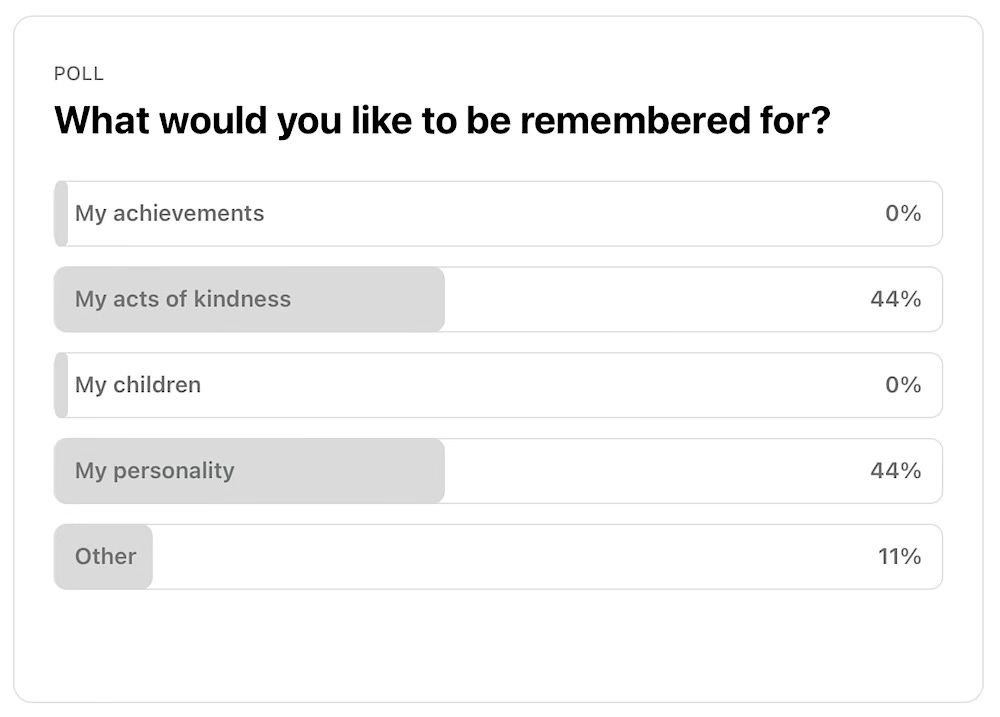
WEEKLY POLL
PREVIOUS POLL

NOTABLE OBITS
* “Outlaw” country singer/songwriter David Allan Coe died at 86. Born in Akron, Ohio, Coe spent his youth in juvenile reformatories and at least four years in prison for auto theft and possession of burglary tools. He was also a member of the Outlaws Motorcycle Club, which has been designated a criminal organization by law enforcement agencies worldwide. Three years out of the joint, Coe released his debut album, “Penitentiary Blues,” which included songs he wrote while behind bars. Other albums featured songs with lyrics that were laden with obscenities as well as misogynistic, racist and homophobic words that he later told Billboard magazine he regretted writing. Coe also wrote several hits for others, including “Would You Lay With Me (In a Field of Stone)” by Tanya Tucker and “Take This Job and Shove It” by Johnny Paycheck. (Bill Friskics-Warren, The New York Times and Greg Evans, Deadline)
* Comics writer Gerry Conway, 73, who created the Marvel characters of Punisher and Ms. Marvel, died. Born in Brooklyn, Conway was just a teenager when he sold his first story to DC Comics. At 18, he landed a job writing superhero stories for Marvel, and contributed to Iron Man, the Incredible Hulk and The Mighty Thor. Conway then replaced Stan Lee as the writer of “The Amazing Spider-Man,” and penned one of the superhero’s most tragic storylines, which began with “The Night Gwen Stacy Died.” Conway also introduced horror elements to Marvel with Man Thing, Dracula and Werewolf by Night. In his later years, he wrote scripts for “Father Dowling Mysteries,” “Law & Order” and “Law & Order: Criminal Intent.” (Jordan Moreau, Variety and George Gene Gustines, The New York Times)
* Forensic scientist Henry C. Lee, who testified for the defense at the 1995 O.J. Simpson trial, died at 87. Born in Rugao, China, Lee and his family fled to Taiwan in the 1940s. After working his way up the ladder at the Taipei City Police Department, Lee immigrated to New York, even though he knew little English. Once in the states, he earned a bachelor’s degree in forensic science from John Jay College of Criminal Justice, followed by a master’s degree and a doctorate from New York University. Lee then joined the University of New Haven, where he founded the forensic science program and taught for 50 years. On the side, Lee testified more than 1,000 times in criminal and civil court cases, including the infamous Simpson trial, where he said there was “something wrong” with the way the Los Angeles Police Department had handled the blood that was collected as evidence. Simpson was later acquitted of the murder of his former wife, Nicole Brown Simpson, and her friend, Ronald L. Goldman. (Jeré Longman, The New York Times)
* Nick Pope, Britain’s foremost “ufologist,” died. He was 60. Pope had no interest in extraterrestrial activity when he was appointed to the “UFO desk” at the UK Ministry of Defence in 1991. Yet it was his job to investigate unexplained phenomena, such as the hundreds of UFO sightings that were reported every year, for any “defence significance.” Two years later, after reading through the archives and conducting a detailed investigation of UFOs that were seen by military witnesses, Pope became a convert. He eventually concluded that while most sightings could be reasonably explained by terrestrial events, 5% simply defied explanation. After leaving the Ministry of Defence in 2006, Pope became a popular media commentator on alien visitation, even though he never had a close encounter himself. He also penned his autobiography, “Open Skies, Closed Minds: For the First Time, a Government UFO Expert Speaks Out,” in which he compared himself to the character of Fox Mulder from the TV show “The X-Files.” (The Telegraph and Michael S. Rosenwald, The New York Times)
* Singer Nedra Talley Ross, the last surviving member of the 1960s girl group the Ronettes, died at 80. Ross and her cousins, Veronica Bennett (who later was known as Ronnie Spector) and Estelle Bennett, first formed the group the Darling Sisters. In 1963, they auditioned for Phil Spector, the famed producer (and future murderer), who signed them to his Philles Records. That’s when they changed their name to the Ronettes. Over the next three years, the Ronettes would release several hits, including “Be My Baby,” “Baby, I Love You,” “Walking in the Rain,” “I Can Hear Music,” “(The Best Part of) Breaking Up” and “Do I Love You.” The group would also tour as the opening act for both the Rolling Stones and the Beatles. In 2007, the Ronettes were inducted into the Rock and Roll Hall of Fame. (Kimberly Nordyke, The Hollywood Reporter)
* Bookseller Jewell Stoddard, who co-founded one of the first children’s-only independent bookstores in the U.S., died. She was 92. Stoddard earned a bachelor’s degree in English literature from American University and spent nearly a decade teaching third and fourth grade. In 1977, she and Charlotte Berman, Helen “Greenie” Neuberg and Pamela Sacks launched Cheshire Cat Children’s Books in Washington, D.C. First daughter Amy Carter was one of the store’s customers on opening day. Stoddard operated the store until 1999, when it closed. She then became the children’s buyer at Politics & Prose, where she was credited with expanding and diversifying the bookstore’s children’s collection. Stoddard also served on several children’s literature award committees, including for the Caldecott and Newbery Awards. (Shannon Maughan, Publishers Weekly and Shelf Awareness)

FAMOUS DEATHS IN HISTORY
On May 4, English children’s author/poet E. Nesbit (65), actor/comedian/chef/author Dom DeLuise (75) and football player/coach Don Shula (90)
On May 5, French military leader/emperor Napoléon Bonaparte (51), Russian chess champion Mikhail Botvinnik (83) and a cappella singer “Sweet Joe” Russell (72)
On May 6, naturalist/author Henry David Thoreau (44), Italian physician/educator Maria Montessori (81) and German-American actress Marlene Dietrich (90)
On May 7, singer/songwriter Eddie Rabbitt (56), movie special effects artist Ray Harryhausen (92) and mezzo-soprano Grace Bumbry (86)
On May 8, French novelist Gustave Flaubert (58), French artist Paul Gauguin (54) and science fiction writer/aeronautical engineer Robert A. Heinlein (80)
On May 9, British hairstylist/businessman Vidal Sassoon (84), British novelist Mary Stewart (97) and singer/songwriter/pianist/architect of rock and roll Little Richard (87)
On May 10, silversmith/patriot Paul Revere (83), Welsh journalist/explorer Henry Morton Stanley (63) and actress Joan Crawford (69-74)
On May 11, Jamaican reggae musician Bob Marley (36), English author Douglas Adams (49) and comedian/actor Jerry Stiller (92)
RECOMMENDED SUBSTACK

FAMOUS LAST WORDS
“Oh, dear!” --English actor/playwright David Garrick
MOMENT OF GRATITUDE
Thanks to Richard Bell, Unsplash, NPR, Bustle, Lisa Keefauver, TEDx Talks, YouTube, The Death Deck, Hello Death: Conversations on Life and Death, The Moonlight Reader Society, The New York Times, Deadline, SyFy, Variety, 5News, The Telegraph, The Hollywood Reporter, Publishers Weekly, Shelf Awareness, The Written Word, On This Day, Playback.FM, Britannica: This Day in History, Time and Date, Wikipedia, Planet Melancholia, Canva and Deposit Photos for art and story suggestions. Note: Generative AI was not used during the ideation, creation or publication of this newsletter.
Also, congratulations to Julie N.! Her name was randomly selected in our monthly giveaway for paid subscribers. The May prize: The book “It’s OK That You’re Not OK: Meeting Grief and Loss in a Culture That Doesn’t Understand” by Megan Devine.
KEEP IN TOUCH
Have you discovered some interesting death-related news? Read a great obituary? Or do you know of someone we should interview? Reach out:
Like this newsletter? Please click the heart button, then forward it to your friends and encourage them to subscribe.
Another amazing video share!!!