Always 'in memory'
Vol. 3, Issue 23


“I didn’t sit on a bench until I was like 12 because they were always ‘in memory’ of someone or another so I just assumed they all died ON those benches and that benches were therefore very dangerous.” —Jonathan Edward Durham
NEWS & NOTES
Its final moments near
The tree hasn’t died, yet it is already starting to rot.
Known to locals as Tsitakakantsa, and viewed as their spiritual anchor, it is one of the largest and oldest baobabs in Madagascar.
Tsitakakantsa has stood in the Andombiry Forest for 1,000 to 1,500 years, and now, the beloved tree has entered its final phase of life. Cracks have developed at its base, and a dark, smelly liquid has started to seep from it.
Soon, experts say, it will collapse and disintegrate.
Also known as the “upside down tree” and the “tree of life,” the massive and resilient baobab is found in Madagascar, Africa and Australia. Baobabs have a thick trunk and a top that looks like roots reaching for the sky. These slow-growing deciduous trees bear fruit, attract tourists and serve a spiritual purpose to locals.
Baobabs can grow over 80 feet tall. They store large amounts of water in the fibrous wood of their trunks, a trait that allows them to survive through the dry season. Although some of these trees have been known to live for 2,000 years, their future may now be at risk.

 Tiktok failed to load.
Enable 3rd party cookies or use another browser
Baobabs are struggling due to deforestation and traditional farming practices, such as using fire to clear land. The nocturnal mammals – bats, lemurs and moths – that act as pollinators for the trees have been hunted or lost their habitat when the understory was cleared for development.
Human-caused climate change is also proving to be a tough adversary to baobabs. Periods of heavy rain are lasting longer. Stronger tropical storms are causing more damage. And under such conditions, root rot and fungal infections can develop and destroy the trees.
“Everyone is very sad,” Mampiavy, the village chief, recently told The New York Times. “Tsitakakantsa brought many blessings to the villages and to the inhabitants. Life without a sacred baobab will be very difficult for us.”
FMI: Click here.
The weight of legacy
The documentary, “Are We Good?” was released in 2025. It chronicles the life and career of Marc Maron, a stand-up comedian, actor and the host of the popular podcast “WTF with Marc Maron.”
Maron has long had a reputation for being acerbic and curmudgeonly. But that all changed when he met filmmaker Lynn Shelton. She adored his sense of humor – and loved him back wholeheartedly.
Then in 2020, at the height of the coronavirus pandemic, Shelton died of acute myeloid leukemia. She was 54. “Are We Good?” reveals how Maron dealt with that experience, processed (and continues to process) the grief, and tried to once again find the funny on stage.
In his new film, “In Memoriam,” Maron tackles grieving from a fictional angle. His character, an egotistical and neurotic actor, learns he’s terminally ill. The only item on his bucket list is to make sure his photo appears in the “In Memoriam” reel during the Academy Awards. Desperate to be remembered after he’s gone, his character will stop at nothing to make that happen.
“In Memoriam” premiered this month at the Tribeca Festival in New York City.
FMI: Click here.
The best advice I’ve ever heard on this topic
SUPPORT THE END FILES
The End Files is a reader-supported newsletter featuring news about death, grief, funerals, mourning and obituaries. Subscriptions are only $5/month, or $50/year. Everyone who purchases a subscription will be automatically entered into a monthly giveaway for books, gift certificates and other prizes.
Know someone else who might enjoy The End Files? Feel free to share it with them:
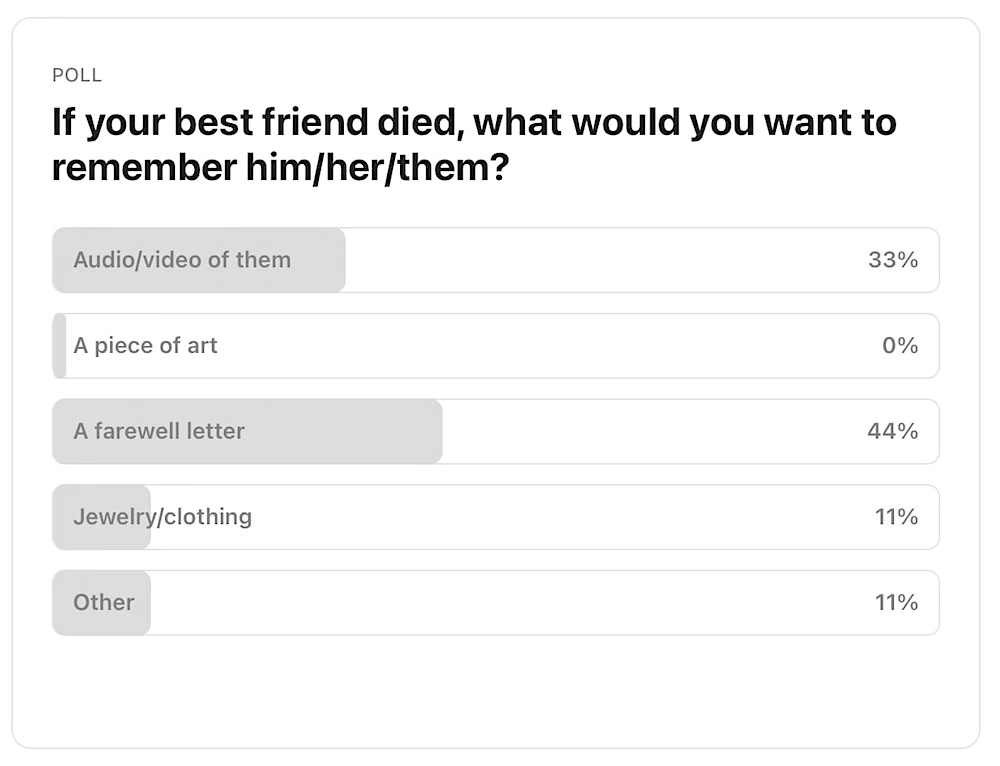
WEEKLY POLL
PREVIOUS POLL

NOTABLE OBITS
* Hall of Fame basketball player and coach Rick Adelman died at 79. Adelman played seven seasons in the NBA as a point guard for five different teams before switching to coaching. He started at Chemeketa Community College in Salem, Ore., then helped coach the Portland Trail Blazers under Jack Ramsey and Mike Schuler. Adelman served as interim coach for the last 35 games of the 1988-89 season before he became the Blazers’ top coach during the 1989-90 season. After Portland, Adelman coached at Golden State and Sacramento. He would eventually win 1,042 games as an NBA coach, the 10th-most in league history. (Tim Reynolds, The Associated Press)
* Convicted killer Betty Broderick has died. She was 78 years old and in her 37th year of incarceration. The native New Yorker married Dan Broderick in 1969, just as he was about to enter medical school. After graduation, he earned a law degree from Harvard and became an attorney focused on medical malpractice. The couple moved to San Diego, where they raised their four children. But Broderick was unhappy and became even more so when her husband left her for his legal assistant, Linda Kolkena. The Brockericks divorced in 1986, then Dan and Linda wed. In 1989, Betty entered the newlyweds’ home and shot both Dan, 44, and Linda, 28, in their bed. Broderick, then 41, turned herself in to the police. Her first murder trial ended in a hung jury; the second led to a conviction on two counts of second-degree murder. She was sentenced to 32 years to life in prison and was twice denied parole. Broderick’s story later served as fodder for books, podcasts, 2 TV movies and a season of the anthology series, “Dirty John.” (Trip Gabriel, The New York Times)
* Celebrated British contemporary artist David Hockney, 88, died. Born in Yorkshire, England, Hockney studied at the Bradford College of Art and the Royal College of Art before graduating with a Gold Medal. He moved from London to Los Angeles in 1964, where he created his famous swimming pool series. In 2018, one of those paintings – “Portrait of an Artist (Pool with Two Figures)” – sold at Christie’s in New York City for $90 million. It was the most expensive artwork by a living artist ever sold at auction. In his later years, Hockney worked in theatre, film, opera and photography and became known for making digital paintings on his iPad. A collection of his iPad creations is currently on show in London’s Serpentine Gallery under the tagline: “Put Your Phone Down, Look with Both Eyes.” (BBC News and Zac Ntim, Deadline)
* Gene Shalit, who was known for his eccentric personality, bushy hair and mustache and punny reviews, died. He was 100. Born in New York City and raised in New Jersey, Shalit always wanted to be a journalist. He was still in elementary school when he launched his first newspaper and later wrote a humor column for his high school paper. After graduating from the University of Illinois at Urbana-Champaign, Shalit began writing film reviews and humor columns for McCall’s, Ladies’ Home Journal and Look magazine. The “Today” show hired Shalit in 1968 to review books once a month. But when he was promoted to arts editor in 1973, he launched the on-air “Critic’s Corner” segment. Although Shalit didn’t possess the handsome features typically found on television, his work and quirkiness made him a star. Over the next four decades, Shalit would serve as an “everyman’s critic,” someone who reviewed the buzzy movies the public actually wanted to see. (Emily St. Martin, Los Angeles Times and Pat Saperstein, Variety)
* Former AP combat photographer Dang Van Phuoc died at 91. Born in a Vietnamese village near Quang Ngai, Phuoc’s father was killed by members of the Viet Cong insurgency. His mother died a few years later, leaving him homeless. Phuoc picked up a camera as a young man and taught himself how to shoot. In 1965, his skills had advanced enough to land him a job at The Associated Press. Over the next decade, Phuoc covered Vietnam for the news service, often putting himself in dangerous situations to capture photos of the war. During that period, he was wounded at least five times, suffering injuries from both grenade explosions and rockets. He was also wounded by a sniper while carrying an injured U.S. soldier to safety, an act that earned him a commendation from the Ninth U.S. Army Infantry Division. When Phuoc lost his right eye in a grenade blast, he taught himself to shoot with just one eye and returned to work. Following the fall of Saigon in 1975, Phuoc and his family fled, first to a refugee camp in Guam and then to the United States, where he would become a professional portrait photographer. (Gillian Flaccus and Hannah Schoenbaum, The Associated Press)

FAMOUS DEATHS IN HISTORY
On June 16, English physician John Snow (45), actor George Reeves (45) and NFL running back Brian Piccolo (26)
On June 17, singer/actor/writer Kate Smith (79), Nobel Prize-winning chemist Donald J. Cram (82) and fashion designer/heiress Gloria Vanderbilt (95)
On June 18, Norwegian polar explorer Roald Amundsen (55), actress Ethel Barrymore (79) and Pulitzer Prize-winning author John Cheever (70)
On June 19, spies Julius Rosenberg (35) and Ethel Rosenberg (37), science fiction writer William Golding (81) and actor Ian Holm (88)
On June 20, English painter John Clayton Adams (65-66), gangster Bugsy Siegel (41) and electrical engineer/inventor who won the Nobel Prize in Physics Jack Kilby (81)
On June 21, Italian statesman/author Niccolò Machiavelli (58), tennis player Maureen Connolly (34) and actor Carroll O’Connor (76)
On June 22, singer/actress Judy Garland (47), former first lady Pat Nixon (81) and comedian George Carlin (71)
RECOMMENDED SUBSTACK

FAMOUS LAST WORDS
“So little done, so much to do.” --Cecil Rhodes
MOMENT OF GRATITUDE
Thanks to Ann, Unsplash, Beth Moon, Instagram, Amazing Planet, YouTube, The New York Times, WTF with Marc Maron, Utopia, IndieWire, IMDb, Awards Radar, Tribeca Festival, Deadline, Bret Simner, TEDx Talks, A Bit of Good News, The Associated Press, Christie’s, BBC News, the Los Angeles Times, Variety, The Moonlight Reader Society, On This Day, Playback.FM, Britannica: This Day in History, Time and Date, Wikipedia, Ask Death, Canva and Deposit Photos for art and story suggestions. Note: Generative AI was not used during the ideation, creation or publication of this newsletter.
KEEP IN TOUCH
Have you discovered some interesting death-related news? Read a great obituary? Or do you know of someone we should interview? Reach out:
Like this newsletter? Please click the heart button, then forward it to your friends and encourage them to subscribe.